The attack on Camp Leyza began on the night of November 28, 2009. By the next morning, U.S. and Afghan forces had found Irek Ilgiz Hamidullin still on the battlefield. Soldiers testified that he fired on them. He was wounded and taken into custody. Nearly five years later, the former Soviet tank commander was brought to the United States to face a federal jury for the attack he had led in eastern Afghanistan.
Key takeaways
- Irek Hamidullin, a former Soviet Army tank commander, led a Taliban and Haqqani Network attack on Camp Leyza, an Afghan Border Police outpost in Khost Province, on November 28, 2009.
- The assault was also meant to bring down the U.S. helicopters that responded. Both anti-aircraft weapons aimed at them malfunctioned.
- He was the first foreign combatant captured in Afghanistan and held at Bagram to be brought to the U.S. for trial. He is serving life plus 30 years at ADX Florence.
- For protection teams: the first incident may not be the real target. Decide who you expose next before you know the attacker’s intent.
The Soviet officer who joined the Taliban
Hamidullin was an officer and tank commander in the Soviet Army. Accounts differ on whether he served in Afghanistan during his Soviet military career. He later converted to Islam. Federal prosecutors said he was a follower of Taliban leader Mullah Omar by around 2001, and that by October 2009 he was communicating with and taking instructions from Sirajuddin Haqqani, a commander in the Haqqani Network.
The fight at Camp Leyza
Camp Leyza was an Afghan Border Police outpost in Tani District, Khost Province, near the Pakistani border. Hamidullin spent months preparing the assault. He recruited fighters, gathered weapons that included heavy machine guns, a shoulder-fired rocket and materials for roadside bombs, and secured approval from Taliban and Haqqani Network leaders. The border post was not the only target. According to the Justice Department, his goal was to shoot down the U.S. helicopters he expected to respond.
Two U.S. Army helicopters did respond. From a nearby hill, Hamidullin radioed his fighters to open fire with the anti-aircraft weapons they had placed. Both weapons malfunctioned. He ordered a withdrawal toward Pakistan, and U.S. forces killed about 20 of his fighters. The next morning, troops assessing the battlefield found Hamidullin hiding there. Two soldiers testified that they saw muzzle flashes from his rifle before they shot him. Hamidullin maintained that he was wounded before he could fire. He was captured after a brief firefight, and the Fourth Circuit’s account identifies him as the lone surviving insurgent.
From Bagram to a courtroom in Richmond
Hamidullin was held at the Parwan Detention Facility at Bagram from 2009 to 2014. As U.S. combat operations wound down, American officials told The Washington Post that Russia showed little interest in taking him back. His transfer marked the first time a foreign combatant captured on the battlefield in Afghanistan and held by the U.S. military at Bagram was brought to the United States for trial.
A federal grand jury in Richmond, Virginia, indicted him in October 2014. On August 7, 2015, a jury convicted him on all 15 counts, including providing material support to terrorists, attempting to kill U.S. military personnel and conspiring to use a weapon of mass destruction. On December 3, 2015, U.S. District Judge Henry E. Hudson sentenced him to life in prison plus 30 years. In 2018, the U.S. Court of Appeals for the Fourth Circuit upheld his convictions and rejected his claim of combatant immunity, and in 2019 the U.S. Supreme Court declined to hear his case. He is serving his sentence at ADX Florence, the federal supermax prison in Colorado.
What protection teams should take from Camp Leyza
The opening incident tells you where the trouble started. Your next decision determines who else you expose. If a disturbance forces a venue or pickup change, the detail lead needs to know who confirmed the new location, what the advance agent has verified, and where the principal can wait while the team checks. At Camp Leyza, the intent behind the initial assault became clear only when investigators and prosecutors reconstructed the attack. Protection teams have to make their decisions while that intent is still unknown.
Frequently asked questions
Where is Irek Hamidullin now?
He is serving a sentence of life in prison plus 30 years at ADX Florence, the federal supermax prison in Colorado, according to the Federal Bureau of Prisons. The U.S. Supreme Court declined to hear his appeal in 2019.
What is combatant immunity, and why didn’t it protect him?
Combatant immunity shields lawful combatants in an armed conflict from prosecution for lawful acts of war. Hamidullin argued that it applied to him. The Fourth Circuit rejected that claim in 2018 and upheld his convictions.
Why was he tried in a U.S. civilian court?
With U.S. combat operations winding down and Russia showing little interest in taking him back, U.S. officials transferred him from Bagram to Virginia for trial in 2014. He was the first foreign combatant captured in Afghanistan and held at Bagram to be tried in the United States.
Related on EP Journal: Before the Attack, Someone Comes to Look: Hostile Reconnaissance Around a Residence · Pre-Incident Indicators: What a Retired CIA Officer Wants Protectors to Watch For
Sources
- Russian Taliban fighter sentenced to life in prison in terrorism case (U.S. Department of Justice, December 3, 2015)
- Russian fighter suspected of terrorism and held in Afghanistan to be prosecuted in U.S. (The Washington Post, October 23, 2014)
- Accused Taliban says U.S. helicopters killed insurgents “like insects” (Reuters via VOA, August 5, 2015)
- United States v. Hamidullin, No. 15-4788 (U.S. Court of Appeals for the Fourth Circuit, 2018)
- Hamidullin v. United States, 139 S. Ct. 1165 (U.S. Supreme Court, 2019)
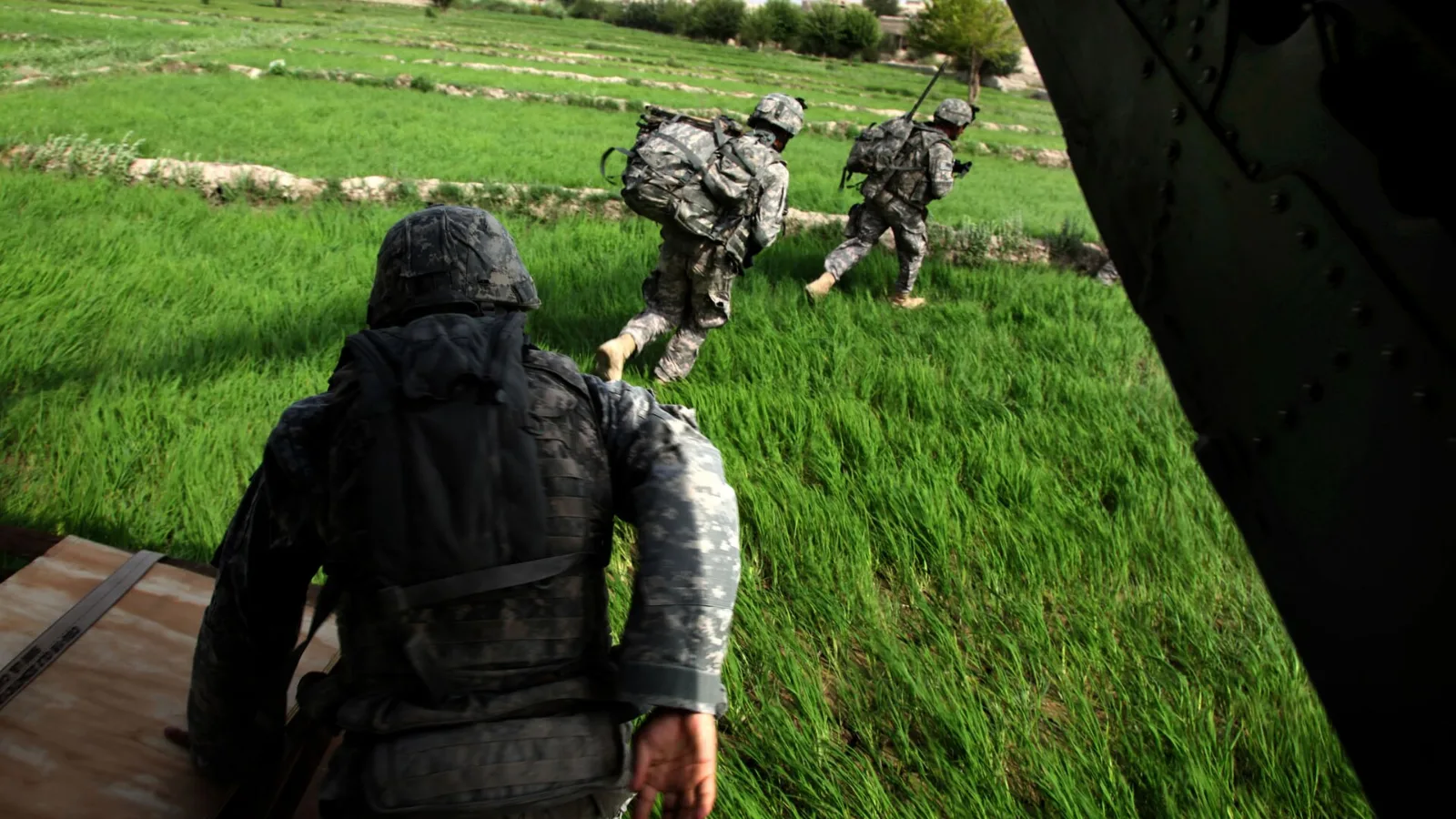
Cover photo: U.S. Army soldiers on an air assault mission in Khost Province, U.S. Army photo (public domain), via Wikimedia Commons. Cropped.