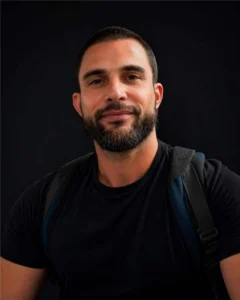
Bob Dougherty spent 25 years as an undercover CIA operations officer, working around the globe, mainly in counterterrorism. He now teaches behavioral analysis and surveillance detection to protection professionals.
His message to protectors starts with a simple claim: violence doesn’t come out of nowhere.
Key takeaways
- Bob tells his students that before targeted violence events, “there’s always pre-incident indicators.”
- The most common mistake Bob sees is judging people by how they look.
- From there, the protector watches for anomalies or deviations from that baseline.
- Bob says someone who is just nervous, drunk or awkward behaves differently from someone who represents a true threat, and the difference shows in their behaviors and actions.
There Are Always Warning Signs
Bob tells his students that before targeted violence events, “there’s always pre-incident indicators.” He describes them as alerting behaviors and actions that the perpetrator is going to undertake before the attack.
He points to 9/11. As Bob describes it, the attackers flew on the flights they planned to hijack, surveilled the airports, worked out how to get through security and figured out how to get into the cockpit, all before the attack itself.
For Bob, that is the case for training more people to see these signs: the more protectors who can spot pre-incident indicators, the more of these events can be stopped before they happen.
Watch Behavior, Not Appearance
The most common mistake Bob sees is judging people by how they look.
“The problem people have is they judge the look of a person rather than the behaviors and the actions.”
Assessing behaviors and actions instead, he says, is more accurate and works everywhere: “You can use this anywhere in the world with any type of people.”
Baseline First, Then Anomalies
For someone a protector has just met, Bob describes a short process. The subconscious mind establishes a normal baseline for that person, which he says only takes a few seconds. The longer you speak with them, the better the baseline becomes.
From there, the protector watches for anomalies or deviations from that baseline. Those deviations are what may indicate a possible threat. Bob says a quick analytical process then drives the decision on what to do.
Nervous Is Not the Same as Dangerous
Not every odd behavior is a threat. Bob says someone who is just nervous, drunk or awkward behaves differently from someone who represents a true threat, and the difference shows in their behaviors and actions.
“They have purpose, they have intent.”
The Signal Your Client Is Sending
Bob says one fact surprises new students more than any other: how widespread technical surveillance is. Phones are tracked. Cars are tracked.
“Every digital device we have is sending out a signal.”
If a client’s electronic devices are on, Bob says, the client can be tracked from point A to point B by them. So can the protectors. The person tracking could be someone who just wants a picture, or an adversary who wants to do the client harm.
The steps Bob describes for reducing that signature include shutting down many of the apps on the phone, choosing settings that keep it from interacting with networks like public Wi-Fi, and, when circumstances merit, shutting the phone off entirely or placing it in a Faraday bag, which blocks its signal.
A Trainable Mindset
Bob doesn’t treat any of this as a gift some people are born with.
“Situational awareness is a mindset and it can be trained to anybody and it can be exercised by anybody with the will and discipline to do so.”
He adds that these skills work for a protector operating alone or as part of a team, and carry over into everyday life as well as the job.
Frequently asked questions
What are pre-incident (pre-attack) indicators?
Bob Dougherty, a retired CIA operations officer, describes them as alerting behaviors and actions that the perpetrator is going to undertake before the attack. He tells his students that before targeted violence events, “there’s always pre-incident indicators.” He points to 9/11: the attackers flew on the flights they planned to hijack, surveilled the airports, worked out how to get through security and figured out how to get into the cockpit, all before the attack itself.
How can a protector tell if someone is a threat?
Watch behavior, not appearance. “The problem people have is they judge the look of a person rather than the behaviors and the actions,” Bob says. For someone a protector has just met, he says the subconscious mind establishes a normal baseline in a few seconds. From there, the protector watches for anomalies or deviations from that baseline.
Is a nervous person a threat?
Not necessarily. Bob says someone who is just nervous, drunk or awkward behaves differently from someone who represents a true threat, and the difference shows in their behaviors and actions. Of a true threat, he says: “They have purpose, they have intent.”
Can situational awareness be trained?
Yes. “Situational awareness is a mindset and it can be trained to anybody and it can be exercised by anybody with the will and discipline to do so,” Bob says. He adds that these skills work for a protector operating alone or as part of a team, and carry over into everyday life.
Can a client be tracked through their phone?
Bob says that if a client’s electronic devices are on, the client can be tracked from point A to point B by them, and so can the protectors. “Every digital device we have is sending out a signal.” The steps he describes include shutting down many of the apps on the phone, choosing settings that keep it from interacting with networks like public Wi-Fi, and, when circumstances merit, shutting the phone off entirely or placing it in a Faraday bag.
Related on EP Journal: The Art of Decision-Making in Executive Protection · Everyone Has a Camera Now: Why Overly Physical Bodyguards Lose the Job · Before the Attack, Someone Comes to Look: Hostile Reconnaissance Around a Residence
Disclosure: Bob Dougherty is a retired CIA operations officer and an instructor at Pacific West Academy, where he teaches behavioral analysis, situational awareness and surveillance detection.