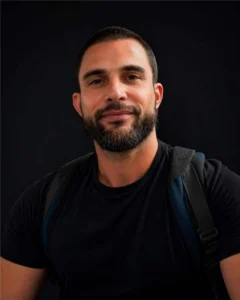
Benji Rosenfeld started in the security industry in 2006, not long after high school, and still works executive protection details today. He has watched the job change, and he says the biggest threat to a protector’s career is often the protector’s own behavior.
Key takeaways
- He says agents who go overboard, too physical, too verbal or both at once, put their long-term employment at risk.
- “The videos are not just coming from the paparazzi anymore,” he says.
- “If we can escape, if we can evade, if we can avoid, those should be the things that we do. That’s really what we’re being paid for.”
- Benji says anytime force is used, justified or not, the likelihood of some kind of legal action is pretty high.
What Gets Agents Fired
Benji is direct about it: “The thing that gets you fired, causing a scene when there’s no reason to cause a scene, being overly physical with someone who didn’t really need physicality.”
He says agents who go overboard, too physical, too verbal or both at once, put their long-term employment at risk.
The Videos Aren’t Just Coming From Paparazzi
When Benji started, not everyone had a camera on their phone. If a situation went badly, the footage usually came from paparazzi.
That has changed. “The videos are not just coming from the paparazzi anymore,” he says. People hold up their own phones, and some wear glasses with cameras built in. The person on the receiving end of rough treatment may now have their own video of it.
And Benji says it isn’t only that person who has a problem with it.
“Your clients expect you to do what needs to be done when it needs to be done, but not before.”
From Paparazzi Hordes to Informed Fans
Back then, Benji says, the number one issue was paparazzi: blocking vehicles, being disruptive, showing up in numbers. Picking up a client at LAX could mean 50 of them.
He says he doesn’t see that level of paparazzi activity anymore, and credits various California laws with cooling things down. What he sees now is a new generation of autograph seeker: extremely well informed, and usually aware of where the client is because of the client’s own social media or media appearances. If a client is booked on a TV show, fans already know where the studio is and where to wait.
Give People a Chance to Move
Benji gives a simple example. If someone is standing in front of him, he can violently push them, or he can give verbal commands as he approaches and prepare them for the possibility that they may be moved if they don’t move.
Most of these people, he says, are just excited to see the client and want an autograph or their moment. The agent still has to stay alert, but recognizing these social situations is a big part of the job.
Avoidance Is the Job
“If we can escape, if we can evade, if we can avoid, those should be the things that we do. That’s really what we’re being paid for.”
Benji calls combatives, shooting and medical skills emergency skills, used “when everything else has failed.” If he is putting a tourniquet or a chest seal on his client, he says, the likelihood that he has already failed to protect that client is pretty high.
Many agents today work alone. Benji describes the solo practitioner model, one client and one agent, where that agent is responsible for basically the client’s entire security apparatus. That makes staying out of unnecessary conflict even more important.
When De-Escalation Stops Working
Benji trains de-escalation and wants agents to use it. He is also realistic about its limits: de-escalation works really well when the other person wants to be de-escalated.
“If he doesn’t want to be de-escalated no amount of verbal gymnastics is going to make him calm down.”
At that point, he says, it becomes a fight, and fighting is physical.
Hurt, Control, Injure or Avoid?
Benji says he can’t teach a full martial art in a short course, but he can teach agents how to think about violence. The questions he gives them:
“Is this a hurt him situation? Is this a control him situation? Or is this an injure him situation? Is this an avoid him situation?”
He also teaches positioning before anything starts: where to stand in relation to the threat and to the client, where the hands are, and what to say. He uses the fence, a concept from Geoff Thompson of the British Combat Association that was originally meant for arm’s-length situations, and extends it to people 10, 15 or 20 yards away, so decisions are made before the agent gets there.
Lawsuits and Justifying Force
Benji says anytime force is used, justified or not, the likelihood of some kind of legal action is pretty high. “You could be sued for doing the right thing or the wrong thing.”
His focus is on using force in ways that are morally, legally and ethically sound. He also questions training that rewards volume over efficiency. Justifying 50 consecutive punches to investigators, he says, is going to be hard. Throwing one strike that accomplishes what needed to be done, then evading or even rendering aid, is what protects the agent afterward.
“So I do believe in aggression, but I think that a lot of training that we see is more about the appearance of aggression.”
Frequently asked questions
What gets a bodyguard fired?
Benji Rosenfeld puts it directly: “The thing that gets you fired, causing a scene when there’s no reason to cause a scene, being overly physical with someone who didn’t really need physicality.” He says agents who go overboard, too physical, too verbal or both at once, put their long-term employment at risk.
Can a bodyguard be sued for using force?
Benji says anytime force is used, justified or not, the likelihood of some kind of legal action is pretty high. “You could be sued for doing the right thing or the wrong thing.” His focus is on using force in ways that are morally, legally and ethically sound.
What de-escalation tactics do bodyguards use?
Benji gives people a chance to move. If someone is standing in front of him, he says, he can violently push them, or he can give verbal commands as he approaches and prepare them for the possibility that they may be moved if they don’t move. Most of these people, he says, are just excited to see the client. He also teaches positioning before anything starts: where to stand in relation to the threat and to the client, where the hands are, and what to say.
Does de-escalation always work?
No. Benji says de-escalation works really well when the other person wants to be de-escalated. “If he doesn’t want to be de-escalated no amount of verbal gymnastics is going to make him calm down.” At that point, he says, it becomes a fight.
Why is avoidance a bodyguard’s first priority?
“If we can escape, if we can evade, if we can avoid, those should be the things that we do. That’s really what we’re being paid for.” Benji calls combatives, shooting and medical skills emergency skills, used “when everything else has failed.”
Related on EP Journal: Should a Bodyguard Be the Client’s Friend? · Great on the Range, Lost in the Scenario: Why Protectors Need More Than Marksmanship
Disclosure: Benji Rosenfeld is the Director of the Combative Department at Pacific West Academy and works executive protection details with Advanced Security Concepts.